Ready-to-Eat (RTE) Food Testing Services
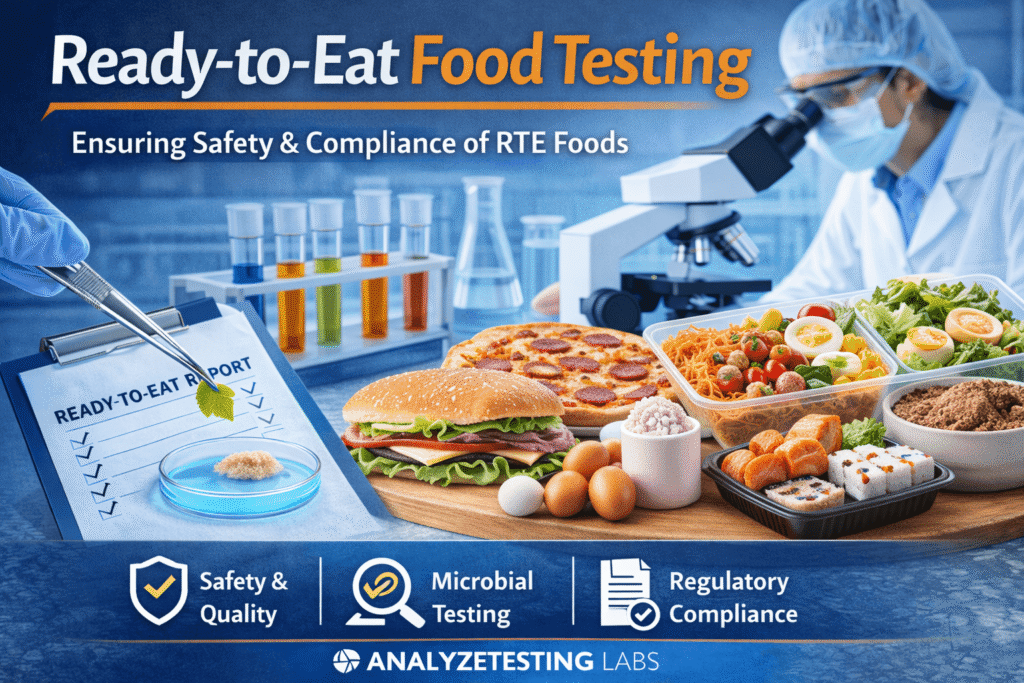
ANALYZETESTING LABS provides comprehensive testing services for Ready-to-Eat (RTE) food products, supporting food safety, regulatory compliance, and quality assurance throughout production and distribution. RTE foods are consumed without further cooking, making them particularly vulnerable to contamination and subject to strict regulatory oversight.
Through our strategic collaboration with Food Safety Net Services (FSNS), we support RTE food processors with access to a North American network of 30+ ISO/IEC 17025 accredited laboratories, operating 24/7/365. Our expertise spans microbiology testing, chemical analysis, contract research, and food safety auditing—delivering accurate results with industry-leading turnaround times.
A well-designed and properly executed Environmental Monitoring Program (EMP) is critical for controlling food safety risks in RTE facilities. However, determining where to swab, how often to sample, and which assays to run can be challenging.
ANALYZETESTING LABS provides expert guidance to help design and optimize robust EMPs that meet regulatory expectations and enhance facility-wide food safety. Our laboratories use validated methods and advanced instrumentation to deliver reliable results that provide clear insight into facility conditions and sanitation effectiveness.
Microorganisms can enter RTE facilities through raw materials, packaging, dust, equipment, and even personnel. Once introduced, pathogens may persist in harborage sites for extended periods, posing significant food safety risks.
We utilize both traditional and rapid-result assays, along with advanced molecular techniques, to help verify product and environmental safety.
Pathogen testing includes:
- Salmonella spp.
- Generic Escherichia coli
- Listeria spp.
- Escherichia coli O157:H7
- Listeria monocytogenes
- Campylobacter spp.
Molecular strain typing is available to help differentiate harborage vs. transient isolates, supporting root-cause analysis and corrective actions.
Testing for spoilage organisms helps determine the effectiveness of sanitation programs and establish baseline microbial levels within RTE production environments. These organisms can contribute to reduced shelf life and product quality issues.
Spoilage organism testing includes:
- Yeast & Mold
- Lactic Acid Bacteria
Indicator organisms provide valuable insight into the overall hygienic condition of food production facilities. Their presence helps verify process controls and sanitation effectiveness.
Indicator organism testing includes:
- Aerobic Plate Count
- Coliforms
- Staphylococcus aureus
- Staphylococcal Enterotoxin
Enterobacteriaceae
- Aerobic Plate Count
In addition to laboratory testing, ANALYZETESTING LABS supports RTE food manufacturers through food safety certification and audit services. Our experienced auditors conduct assessments against leading certification schemes to help facilities demonstrate compliance and continuous improvement.
Audit & certification services include:
- SQF
- BRCGS Food Safety
- FSSC 22000
- GMP Audits
Our audit approach emphasizes practical value and consistent service quality.
- SQF
ANALYZETESTING LABS supports digital EMP management through advanced tools that replace spreadsheets and manual binders.
Key features include:
- Automated environmental monitoring workflows
- Real-time data visualization
- Customizable swabbing plans
- Corrective action tracking for failed sites
- Secure, cloud-based data storage
These tools simplify EMP management while saving time and resources.
- Automated environmental monitoring workflows
Beyond routine testing, ANALYZETESTING LABS provides contract research and scientific study services through FSNS Lab+. Our scientists design and conduct studies that generate actionable data to verify product safety and process effectiveness.
Scientific services include:
- Shelf-Life Studies
- Stability Studies
- Process Validations
- Microbial Strain Typing
- Custom Research Studies
Results are communicated clearly and aligned with operational and regulatory decision-making needs.
- Shelf-Life Studies
Even shelf-stable RTE products such as crackers, chocolate, and peanut butter require appropriate testing to verify contamination controls.
Critical tests for shelf-stable RTE products typically include:
- Listeria spp.
- Listeria monocytogenes
- Salmonella spp.
- Allergen Testing
These tests help confirm the effectiveness of preventive controls and protect consumers.
- Listeria spp.
ANALYZETESTING LABS
So The World Can Trust In What It Consumes
analyzetestinglabs partners with customers to deliver innovative scientific solutions and expertise in support of the food & beverage, cosmetic, OTC, supplements, and other regulated industries.

Why Choose ANALYZETESTING LABS for RTE Testing
With over 20 years of laboratory experience, ISO/IEC 17025 accredited facilities, and a strategic collaboration with FSNS, ANALYZETESTING LABS delivers RTE testing data you can trust. Our comprehensive services help RTE food manufacturers mitigate contamination risks, meet regulatory requirements, and maintain product quality across domestic and international markets.